Easy Way to Upload to Amazon S3
In web and mobile applications, it'south common to provide users with the power to upload data. Your application may allow users to upload PDFs and documents, or media such equally photos or videos. Every modern web server engineering science has mechanisms to permit this functionality. Typically, in the server-based surroundings, the process follows this menstruation:
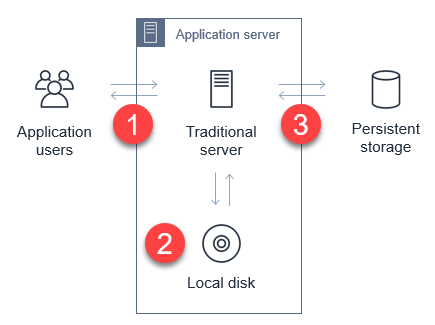
- The user uploads the file to the application server.
- The application server saves the upload to a temporary space for processing.
- The application transfers the file to a database, file server, or object store for persistent storage.
While the process is simple, it can accept significant side-furnishings on the performance of the web-server in busier applications. Media uploads are typically large, and so transferring these tin can represent a large share of network I/O and server CPU time. You must also manage the state of the transfer to ensure that the unabridged object is successfully uploaded, and manage retries and errors.
This is challenging for applications with spiky traffic patterns. For case, in a web awarding that specializes in sending holiday greetings, information technology may experience most traffic only around holidays. If thousands of users attempt to upload media around the same time, this requires you to scale out the awarding server and ensure that there is sufficient network bandwidth available.
By directly uploading these files to Amazon S3, you can avoid proxying these requests through your application server. This can significantly reduce network traffic and server CPU usage, and enable your application server to handle other requests during busy periods. S3 as well is highly available and durable, making it an ideal persistent store for user uploads.
In this blog post, I walk through how to implement serverless uploads and testify the benefits of this approach. This pattern is used in the Happy Path web awarding. You can download the code from this blog post in this GitHub repo.
Overview of serverless uploading to S3
When you lot upload straight to an S3 saucepan, you must first request a signed URL from the Amazon S3 service. You tin can then upload direct using the signed URL. This is two-step process for your application forepart end:

- Telephone call an Amazon API Gateway endpoint, which invokes the getSignedURL Lambda office. This gets a signed URL from the S3 saucepan.
- Straight upload the file from the awarding to the S3 saucepan.
To deploy the S3 uploader case in your AWS business relationship:
- Navigate to the S3 uploader repo and install the prerequisites listed in the README.md.
- In a terminal window, run:
git clone https://github.com/aws-samples/amazon-s3-presigned-urls-aws-sam
cd amazon-s3-presigned-urls-aws-sam
sam deploy --guided
- At the prompts, enter s3uploader for Stack Name and select your preferred Region. Once the deployment is complete, note the APIendpoint output.The API endpoint value is the base URL. The upload URL is the API endpoint with
/uploadsappended. For instance:https://ab123345677.execute-api.us-west-2.amazonaws.com/uploads.

Testing the application
I show 2 ways to test this application. The first is with Postman, which allows you to directly call the API and upload a binary file with the signed URL. The 2d is with a basic frontend application that demonstrates how to integrate the API.
To test using Postman:
- First, copy the API endpoint from the output of the deployment.
- In the Postman interface, paste the API endpoint into the box labeled Enter request URL.
- Choose Ship.

- After the asking is complete, the Torso section shows a JSON response. The uploadURL attribute contains the signed URL. Copy this attribute to the clipboard.
- Select the + icon side by side to the tabs to create a new asking.
- Using the dropdown, change the method from GET to PUT. Paste the URL into the Enter asking URL box.
- Cull the Body tab, then the binary radio button.

- Choose Select file and choose a JPG file to upload.
Choose Send. You lot see a 200 OK response after the file is uploaded.
- Navigate to the S3 console, and open the S3 bucket created by the deployment. In the bucket, you lot see the JPG file uploaded via Postman.

To test with the sample frontend application:
- Copy index.html from the case's repo to an S3 bucket.
- Update the object's permissions to go far publicly readable.
- In a browser, navigate to the public URL of index.html file.

- Select Choose file and and so select a JPG file to upload in the file picker. Choose Upload prototype. When the upload completes, a confirmation message is displayed.
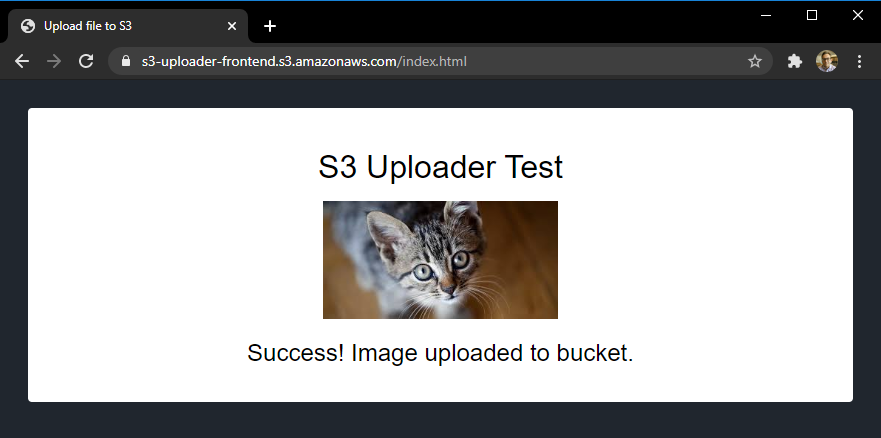
- Navigate to the S3 console, and open the S3 bucket created by the deployment. In the saucepan, you lot meet the second JPG file you lot uploaded from the browser.

Understanding the S3 uploading process
When uploading objects to S3 from a spider web application, you must configure S3 for Cross-Origin Resources Sharing (CORS). CORS rules are defined equally an XML document on the saucepan. Using AWS SAM, you tin configure CORS as part of the resource definition in the AWS SAM template:
S3UploadBucket: Type: AWS::S3::Bucket Properties: CorsConfiguration: CorsRules: - AllowedHeaders: - "*" AllowedMethods: - GET - PUT - HEAD AllowedOrigins: - "*" The preceding policy allows all headers and origins – information technology'south recommended that y'all use a more restrictive policy for product workloads.
In the first stride of the process, the API endpoint invokes the Lambda function to make the signed URL request. The Lambda function contains the post-obit code:
const AWS = require('aws-sdk') AWS.config.update({ region: process.env.AWS_REGION }) const s3 = new AWS.S3() const URL_EXPIRATION_SECONDS = 300 // Main Lambda entry bespeak exports.handler = async (upshot) => { return await getUploadURL(outcome) } const getUploadURL = async function(event) { const randomID = parseInt(Math.random() * 10000000) const Key = `${randomID}.jpg` // Get signed URL from S3 const s3Params = { Bucket: procedure.env.UploadBucket, Key, Expires: URL_EXPIRATION_SECONDS, ContentType: 'epitome/jpeg' } const uploadURL = await s3.getSignedUrlPromise('putObject', s3Params) return JSON.stringify({ uploadURL: uploadURL, Key }) } This function determines the proper noun, or key, of the uploaded object, using a random number. The s3Params object defines the accustomed content blazon and also specifies the expiration of the key. In this case, the central is valid for 300 seconds. The signed URL is returned every bit function of a JSON object including the key for the calling awarding.
The signed URL contains a security token with permissions to upload this single object to this bucket. To successfully generate this token, the lawmaking calling getSignedUrlPromise must have s3:putObject permissions for the bucket. This Lambda function is granted the S3WritePolicy policy to the bucket past the AWS SAM template.
The uploaded object must match the aforementioned file name and content blazon as defined in the parameters. An object matching the parameters may be uploaded multiple times, providing that the upload process starts before the token expires. The default expiration is 15 minutes only you may desire to specify shorter expirations depending upon your use case.
One time the frontend application receives the API endpoint response, it has the signed URL. The frontend application then uses the PUT method to upload binary data directly to the signed URL:
let blobData = new Hulk([new Uint8Array(array)], {blazon: 'image/jpeg'}) const upshot = await fetch(signedURL, { method: 'PUT', body: blobData }) At this point, the caller application is interacting directly with the S3 service and not with your API endpoint or Lambda function. S3 returns a 200 HTML status code in one case the upload is complete.
For applications expecting a large number of user uploads, this provides a simple way to offload a large amount of network traffic to S3, away from your backend infrastructure.
Adding authentication to the upload process
The electric current API endpoint is open, available to whatever service on the internet. This means that anyone tin can upload a JPG file once they receive the signed URL. In most production systems, developers desire to use authentication to command who has access to the API, and who tin upload files to your S3 buckets.
You can restrict access to this API by using an authorizer. This sample uses HTTP APIs, which support JWT authorizers. This allows you to control access to the API via an identity provider, which could be a service such every bit Amazon Cognito or Auth0.
The Happy Path application only allows signed-in users to upload files, using Auth0 as the identity provider. The sample repo contains a second AWS SAM template, templateWithAuth.yaml, which shows how you tin add an authorizer to the API:
MyApi: Type: AWS::Serverless::HttpApi Properties: Auth: Authorizers: MyAuthorizer: JwtConfiguration: issuer: !Ref Auth0issuer audience: - https://auth0-jwt-authorizer IdentitySource: "$request.header.Authorization" DefaultAuthorizer: MyAuthorizer Both the issuer and audition attributes are provided by the Auth0 configuration. By specifying this authorizer every bit the default authorizer, information technology is used automatically for all routes using this API. Read part one of the Ask Around Me series to learn more well-nigh configuring Auth0 and authorizers with HTTP APIs.
After authentication is added, the calling web application provides a JWT token in the headers of the asking:
const response = await axios.get(API_ENDPOINT_URL, { headers: { Say-so: `Bearer ${token}` } }) API Gateway evaluates this token before invoking the getUploadURL Lambda function. This ensures that merely authenticated users can upload objects to the S3 saucepan.
Modifying ACLs and creating publicly readable objects
In the electric current implementation, the uploaded object is not publicly accessible. To make an uploaded object publicly readable, you lot must gear up its access control list (ACL). There are preconfigured ACLs available in S3, including a public-read option, which makes an object readable by anyone on the internet. Set the advisable ACL in the params object before calling s3.getSignedUrl:
const s3Params = { Bucket: procedure.env.UploadBucket, Cardinal, Expires: URL_EXPIRATION_SECONDS, ContentType: 'image/jpeg', ACL: 'public-read' } Since the Lambda function must accept the appropriate bucket permissions to sign the request, you must also ensure that the function has PutObjectAcl permission. In AWS SAM, you tin add the permission to the Lambda part with this policy:
- Statement: - Consequence: Allow Resource: !Sub 'arn:aws:s3:::${S3UploadBucket}/' Activity: - s3:putObjectAcl Conclusion
Many web and mobile applications allow users to upload data, including large media files similar images and videos. In a traditional server-based awarding, this can create heavy load on the awarding server, and also employ a considerable amount of network bandwidth.
By enabling users to upload files to Amazon S3, this serverless pattern moves the network load away from your service. This can make your application much more scalable, and capable of handling spiky traffic.
This blog mail walks through a sample application repo and explains the process for retrieving a signed URL from S3. It explains how to the test the URLs in both Postman and in a web awarding. Finally, I explain how to add authentication and brand uploaded objects publicly accessible.
To learn more than, meet this video walkthrough that shows how to upload directly to S3 from a frontend web application. For more serverless learning resources, visit https://serverlessland.com.
Source: https://aws.amazon.com/blogs/compute/uploading-to-amazon-s3-directly-from-a-web-or-mobile-application/
0 Response to "Easy Way to Upload to Amazon S3"
Yorum Gönder